
Is it time for colleges to sell off their football and basketball teams?
We could call it divestiture – a process whereby the big college football factories could sell those programs to local billionaires who would run them as private businesses.
Let’s face it; the old model is dead.
Prior to NIL, there were two benefits to the players. First, they could play college ball and see if they had the talent to move to the NFL or the NBA. Second, and this seems laughable today, they could get a free education. To me, as a fan, I wanted to see players in Austin that had dreamed of being a Longhorn – like Sam Ehlinger and Hudson Card, or perhaps Earl Campbell. Now, they come to UT or any other college for the money. The new “Protect College Sports Act” fixes a few things, but not the concept of the student-athlete. Why, then, should colleges own teams at all?
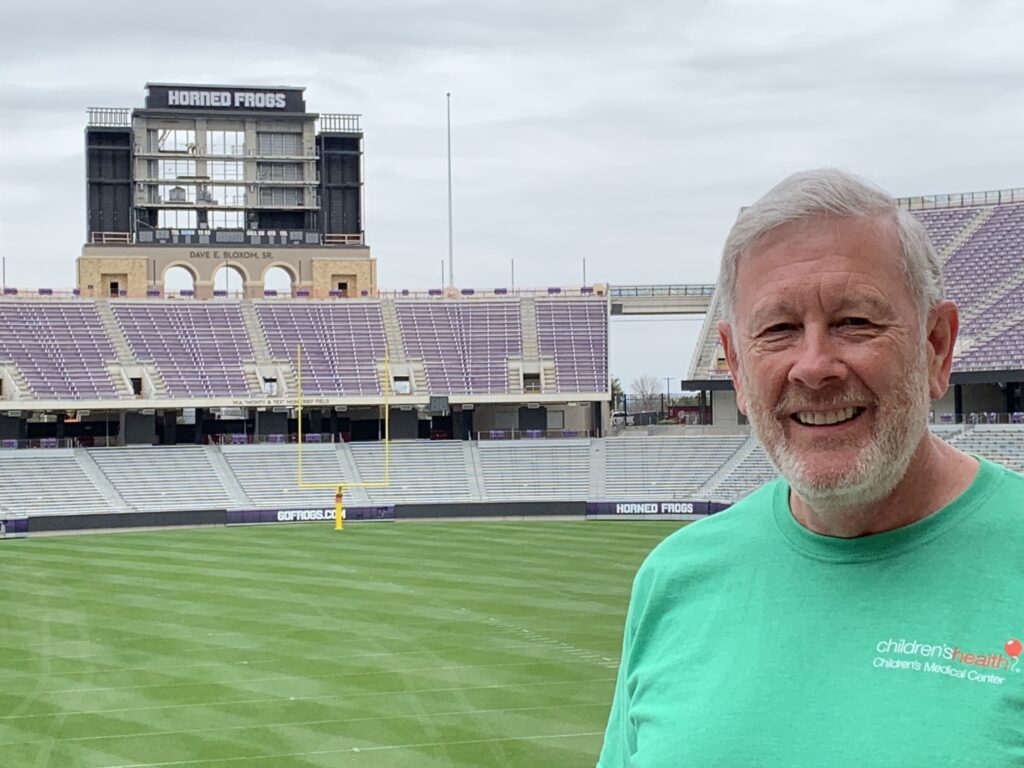
Lynn Woolley at TCU’s Amon Carter Stadium on 11-13-19.
Perhaps ESPN could purchase the SEC and Fox Sports could buy the Big Ten.
That would keep them competitive as the networks would want to telecast good games on Saturdays. CBS and NBC might purchase the Big 12 and the ACC, and they’d have plenty of content throughout the football and baseball seasons. It might even be a part of the deal that the teams continue to play on campus using existing stadia, and with a percentage of profit going to the colleges to fund swimming, tennis, and volleyball.
The other way would be to have a local rich person buy the team, and own it as Jerry Jones owns the Dallas Cowboys. I will note here that, other than living in Dallas for seven years, I have no connection with the Cowboys. The team is a business intended to make money, the NFL has homogenized the league, even bragging that “on any given day” any team can beat any other. To me, that’s a boring business model.
AUDIO: Random Samplings of a Logical Mind
RELATED: Junk Academics on the Way Out at Texas Colleges
In college football, when Boise State began to beat the bluebloods, that was fun and exciting. It was about which players you could recruit and what a coach could do with two-star players while other coaches had 5-star players. You may remember when Baylor and TCU were regularly beating big-name teams. Baylor and TCU were doing that mostly with recruits the big schools didn’t want. That was fun to watch.
So! Will the new legislation make anything better? That’s doubtful.
To begin with, the Protect College Sports Act, championed by Senator Ted Cruz of Texas, seeks to regulate a lot of things involving the players – but there are no chains put upon the coaches. There is no salary cap to stop the ridiculous amounts of money that head coaches and their assistants make – and that was one of the legitimate gripes the players always had. The coaches risked no broken bones, but they all became multi-millionaires while the players worked for free (except for their scholarships, which now mean virtually nothing).
RELATED: America’s Colleges and Universities Should Be Fully Investigated
There is nothing to stop schools like Texas A&M that want to win so badly, they will fire a coach and hire another one, while still having to pay out millions of dollars to the coach who was fired. Per Wikipedia:
The Aggies would enter the 2022 with high expectations, ranked #6 in the country. They lost six of their first nine games, including a shocking upset loss to unranked Appalachian State in the Aggies’ second game. The Aggies suffered through a six-game losing streak during the season. 2022 marked the first time the Aggies had lost six consecutive games since the 1972 season. The team finished with a 5–7 mark, missing a bowl game, but ending the season on a positive note with an upset 38–23 victory over #5 LSU. Fisher was fired as head coach on November 12, 2023, after having a 6–4 record through 10 games. His contract was bought out for $77.5 million, the largest buyout in college football history.
This type of obsession with winning, and paying coaches outrageous amount of money to win and fill up 100,000-seat stadia in places like Austin, College Station, Knoxville, Columbus, and Ann Arbor led to contracts such as the one Fisher got. He was able to assure his millionaire status – win or lose. UT’s Steve Sarkisian’s salary, per USA TODAY, puts him in the top ranks:
Texas’s Steve Sarkisian is the No. 5 highest-paid coach in college football, according to USA TODAY’s 2025 compensation survey. The Longhorns coach is set to earn a total of $10,800,000, not including bonuses, which ranks No. 2 in the Southeastern Conference… As of Dec. 1, 2025, if the school fires Sarkisian without cause, he would be set to receive $60,307,500, which ranks as the No. 4 most expensive buyout out of the 105 USA TODAY’s could review and No. 3 in the Southeastern Conference.
A glance at the provisions of the new legislation shows nothing to stop or even slow down this type of insanity.
What the legislation does.
In fairness, it would accomplish some good things –assuming you think college sports is something the Congress of the United ought to be engaged in – but then, the courts got involved and helped make this mess, so why not?
Here are a few things the bill would do:
- Increases the amount of money schools can spend on direct payments to their players by $27.5 million, more than doubling the current $21.5 million cap.
- Cracks down on rich colleges (think Texas, Texas A&M, Ohio State, Alabama, Georgia, etc.) to stop them from arranging endorsement deals for players.
- Prevents Power-4 conferences from expanding beyond 19 teams, thus stopping a Big 10 – SEC merger.
- Allows athletes to transfer just one time during a career without having to sit out a year.
- Limits athletes to a 5-year window of eligibility.
Will this “fix” college football or basketball? No, but it will help stop some of the things that make fans pull their hair out – such as a player switching teams virtually every season. That might lessen the prospect of teams that have billionaire donors (Indiana, Texas Tech) but don’t win national titles to be able to essentially buy a national championship.
RELATED: Colleges and Universities are a Big Part of What’s Wrong with America
How did this bill come about?
It came about the same way a lot of bills do. People with varied interests and a lot of money hired powerful lobbyists to make sure it was written the way they wanted. Welcome to the Swamp, which Donald Trump never did drain.
If you think ESPN and Fox Sports sat back to watch from the sidelines, then perhaps we need sideline reporters in Congress to explain the crap that goes on. According to Dan Murphy, a reporter at ESPN’s Investigative and Enterprise Team, ESPN, Fox Sports, and their parent companies invested heavily in the outcome. Murphy reports that Disney and companies such as Paramount Skydance (parent of CBS), reported in financial documents that they all paid lobbyists to influence the Protect College Sports Act.
Team spirit is a thing of the past in college football and basketball.
On the Cardle & Woolley Show on Austin’s Talk 1370, I asked a member of an ACC radio broadcast team if the players attend classes. You can guess his answer.
Maybe we should stop pretending this is “college football” and just admit that it is another professional league meant for younger players who will someday move to the NFL if they have the right stuff. Maybe some type of connection to the colleges would be all right so we can still call the team in Austin the Texas Longhorns – but that would be ceremonial and for tradition’s sake.
Maybe you have a better idea, but what we have now has removed many of the reasons that people like me preferred college football over professional football. As I mentioned, I have problems cheering for the Dallas Cowboys because I have no connection with the team. Sadly, other than a paycheck, most of the Texas Longhorns players have no connection with their team.
 Lynn Woolley is a Texas-based author, broadcaster, and songwriter. Follow his podcast at https://www.PlanetLogic.us. Check out his author’s page at https://www.Amazon.com/author/lynnwoolley.
Order books direct from Lynn at https://PlanetLogicPress.Square.Site. Email Lynn at lwoolley9189@gmail.com.
Seems like everyone has some Darker Secrets.