
Divergences, Convergences, and Futurephobia
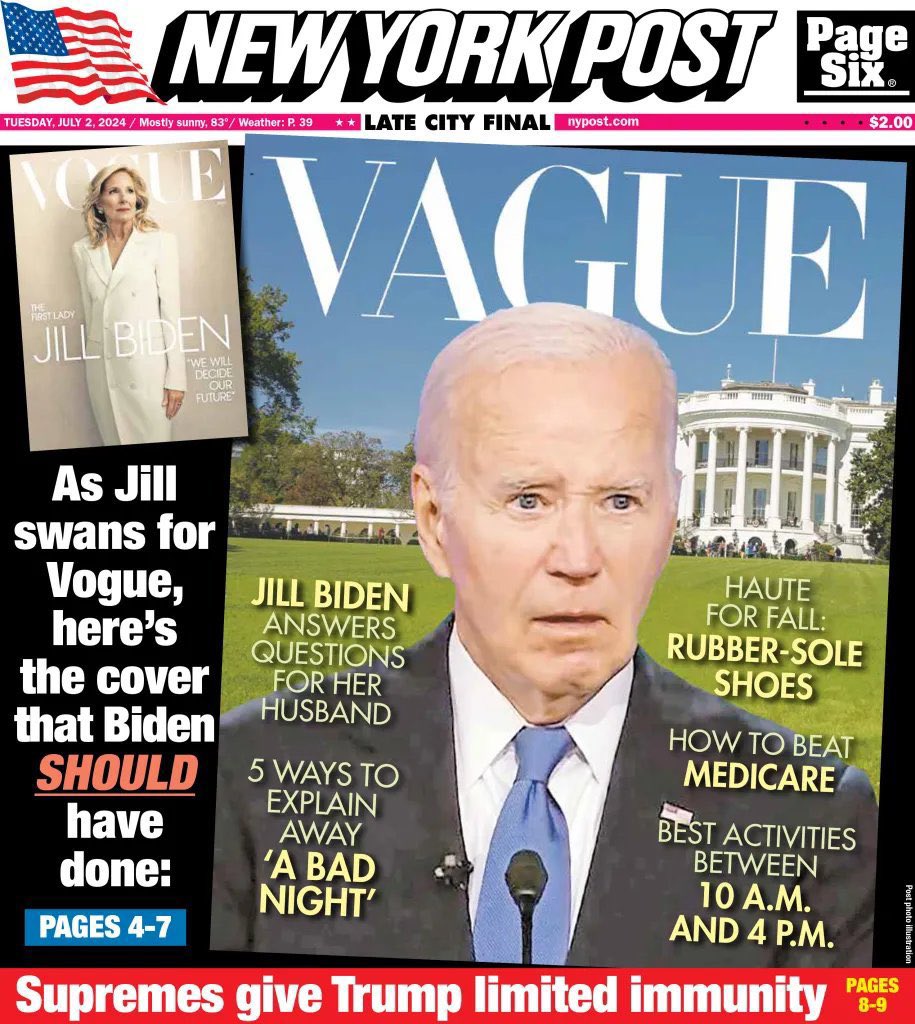
New York Post 7/2/24 – Biden saw a lot of convergences (Fair Use)
Just a few short months ago, political commentators were writing about the possible demise of the Democratic Party. That would have been a divergence – a major turn of events leading to a far different future. This divergence had a cause, namely the Democrats’ odd agenda of open borders, sexual fluidity, and the new Democratic Socialism.
But another event happened at the same time when President Trump decided to go to war with Iran.
That formed a convergence – two major changes in the political norm happening concurrently. One without the other leads to an ultimate end that would not have occurred in a vacuum. Had President Trump suffered from futurephobia—the fear of making a wrong choice – there might have been no convergence.
In that case, we might have said goodbye to the Democratic Party.
AUDIO: Random Samplings of a Logical Mind
I love it when certain passages from my own stories can explain current events.
I’m not claiming that these three concepts were unique to my short stories and novels; just that in two of my books, I pulled them all together in a way that virtually defines our current situation in at least two instances.
One of these events is taking place on a national/international scale, and other is happening in Texas. I’ll get to them in a moment.
What is a “divergence?”
Have you ever thought: Things were really going good until “that” happened?
A few years ago, my day was running as normal until I drove off a parking lot during a heavy mist, and got slammed by a car that was moving too fast on a side street. The front of my car was crumpled, my airbags deployed, and my day changed by 180 degrees. For several weeks, nothing was the same as I dealt with my insurance company, and the hassle of buying a new car.
In my novel “Rules of Ascension,” (one of the three related stories in the collection Stitches in Time), a major divergence causes an entire new history to unfold in a parallel universe. The plot of the story involves certain things in this other universe that had occurred differently – a minor thing like not taking a certain bus – and history was changed. This sequence provides an example:
He wanted his stasis room to lock onto the space-time continuum and scan for something the Good Doctor referred to as a “divergence.” That was an instance in time in which a timeline might snake off into some other direction. In the case of Tony Sutton, a divergence had occurred when the timeline split and Sutton had not taken a solar-bus on the day the repeller systems failed. The original timeline continued as normal, but in the divergence, Tony Sutton was never killed. In making a time splice, the Girard machine effectively shifted the other Tony from his timeline to this one, and in this reality, Tony Sutton had a new lease on life.
Another divergence in this parallel world was that President Franklin Delano Roosevelt never was stricken with polio. That had a major effect on World War II and its outcome. Essentially, all events that took place, because of that one change in reality, led to other changes that significantly changed history.
RELATED: The Power of Logical Thinking
In the real world, I believe that the Democrats’ foray into what some people refer to as “crazy politics” is a divergence. Democrats have always provided a “progressive” alternative to the more traditional views held by Republicans, but they’ve never been like this. I was astounded when President Joe Biden opened the border. Many, on both sides of the aisle, still can’t fathom why Democrats opted to support the idea that a person’s sex is a matter of choice and that men should compete in women’s sports. And now comes the Marxist movement within the party that threatens to destroy the very foundations of what Democrats have always believed.
It was a “dead-party-walking” situation, until another divergence took place. Donald Trump decided to go war with Iran. Two divergences at the same time form a convergence.
What is a “convergence?”
A convergence is when two divergences happen simultaneously. Note that without Trump’s entry into this war on Iran, the looniness of the Democratic Party might have destroyed it. But the second divergence changes all that. Democrats, who might not have had much chance at the polls perhaps can still win and even win big.
Here’s a sequence from “Rules of Ascension” in which the protagonist of the novel, David Brothers, is considering all the things that might happen because of his travels to a parallel universe where there is another version of himself:
How many events does it take to form a convergence, he wondered? What about two identical men – each David Brothers – from parallel realities meeting and almost touching? What would that do to the timeline? What if you combined that with two Dr. William Girards in different worlds – each tapping into the time continuum, desperately trying to repair their respective realities? What if these things were happening at the same time as the mushroom cloud of a nuclear explosion was rising into the sky?
That seemed to Brothers to have the makings of a strong convergence. And convergences lead to divergences as he had discovered.
Two momentous things happening at the same time. In the story, David Brothers is about to be executed when the Russians set off a nuclear explosion. The plot thickens, as they say, and the ending is nothing like you might expect. In the real world, what will the war to do President Trump’s legacy? Will the war, and opposition to it, revive the moribund Democratic Party? These things remain to been seen and will play out over time. One thing’s for sure. If either one, or both of these events had not taken place, the future would have been very different.
But can you change the future? One of my characters tried that, rather unsuccessfully. Perhaps there’s still time for President Trump to give it a try.
What is “futurephobia?”
I’m pretty sure I coined this word, but maybe there’s some earlier reference to it on the internet. In my story “The Clock Tower” from the book by the same name, my lead character is told by a fortune teller that he’s going to die at the bottom of a tall building with four clocks at the top. He believes the prediction is a fraud, but it still worries him. So, he takes steps to avoid such a fate.
He develops a condition the story calls futurephobia in which he over-analyses every move he makes to avoid unwanted results. This sequence from the story explains it in the protagonist’s words:
Every time you take any kind of action, you have just changed history. At the very least, you’ve changed your history and that of a few other people. Here’s what I mean: When you drive to work each morning, you typically take the same route. What if you decided one day to take an alternate way to the office – and you slammed into a school bus? By making that decision, you’ve affected the bus driver and his young passengers, caused at least two insurance companies to get involved – and you could be dead!
Remember that automobile accident I was in? I eased out into the street on a day with poor visibility and lots of parked cars blocking the view. That parking lot has two entrance and exit points. Had I taken the other one, I would have avoided the wreck. It’s really that simple. The choice I made was the difference.
In President Trump’s case, the decision to return to Iran with more attacks after the successful “Midnight Hammer” operation has made a profound difference. The earlier operation to destroy Iran’s nuclear capabilities was hailed as a success, even by some of the President’s political adversaries. So was the mission into Venezuela which went quite well.
RELATED: Can Donald Trump Change the World?
Like my poor choice of which exit to use from that parking lot, Trump’s decision to go back to Iran is having consequences. American soldiers have been killed and Iran has proved to be no Venezuela. However, unlike divergences and convergences, the President still has choices he can make. They range from all-out destruction of Iran to simply declaring victory and pulling out our troops.
A major convergence in Texas.
Here’s another instance of two big things happening at once. In Texas, Attorney General Ken Paxton won the nomination from long-time incumbent Senator John Cornyn. But Paxton’s political and marital baggage is extensive. Democrats are seizing on it to brand him as a sleazy candidate that voters ought to reject on principle. They may be right. Paxton’s background would give pause to any voter that cares about character. By all rights, he should lose, except for a convergence.
RELATED: A Brief History of James Talarico
The Democrats nominated State Rep. James Talarico, a “seminarian” and Christian who, by his own admission, hates Christianity. Earlier in this column, we talked abut the looniness of the Democratic Party with its mixed- up views on open borders and sexual craziness. Talarico is the literal embodiment of all that. So, here’s what we have in Texas:
A Republican candidate that, under normal circumstances, should not even be nominated, much less win the office of U.S. Senator. And a Democratic candidate who is the poster boy for left-wing insanity.
What does all this mean?
These three concepts make for great science-fiction stories. But they also have meaning in the real world of politics. Had Joe Biden not opened the border (converging with his mental decline), he might have won a second term. Had Donald Trump stopped at Midnight Hammer and not started the Iran war, the Democratic Party might have been doomed.
Oh, but the “howevers” never stop. Had the Democrats not gone so loopy with their agenda, they would not have been in danger in the first place. But the Dems are certifiably crazy, and we are (at this writing) mired in Iran, and voters have to weigh one thing against the other. Convergences cause divergences and that’s right where we are in international politics and in the Texas Senate race.
The choices we make in life are all important – even the little ones. As they say, the future isn’t what it used to be.

The three fiction books by Lynn Woolley
Lynn Woolley is a Texas-based author, broadcaster, and songwriter. Follow his podcast at https://www.PlanetLogic.us. Check out his author’s page at https://www.Amazon.com/author/lynnwoolley.
Order books direct from Lynn at https://PlanetLogicPress.Square.Site. Email Lynn at lwoolley9189@gmail.com.
For divergences & convergences, read “Rules of Ascension” in STITCHES IN TIME. For futurephobia, read “The Clock Tower” in THE CLOCK TOWER AND OTHER STORIES.